

Uncertainty in investing can be deeply unsettling, but learning to live with it is one of the most valuable skills any investor can develop. Here we explore why our fear of the unknown often sabotages good decisions, and how you can turn that fear into a long-term advantage.
It's 3am and you're scrolling through your investment app. Global markets have dropped 8% this week. Your stomach churns as you contemplate hitting "sell all". At least then you'd know exactly where you stand. If this feels familiar, you're experiencing what psychologists call "intolerance of uncertainty", and it's costing you money. As horror writer H.P. Lovecraft observed over a century ago, "the oldest and strongest emotion of mankind is fear, and the oldest and strongest kind of fear is fear of the unknown."
Fear of the unknown drives poor investment choices
Our discomfort with not knowing what comes next runs deeper than simple market anxiety. A groundbreaking study by Nicholas Carleton in 2016 proposed that fear of the unknown represents a fundamental human fear underlying most anxiety disorders. This connects directly to investment behaviour. Research published in the Journal of Anxiety Disorders in 2015 found that reducing intolerance of uncertainty during cognitive behavioural therapy led to significant reductions in worry. The reverse wasn't true — reducing worry alone didn't address uncertainty intolerance. Learning to tolerate uncertainty is the key mechanism for reducing financial anxiety. Daniel Crosby, in his insightful book The Soul of Wealth, describes how our distaste for not knowing becomes so overwhelming that we're compelled to fill that uncomfortable space with anything — no matter how destructive. We literally prefer bad news to no news. Those undergoing health crises found their anxiety peaked not when receiving a cancer diagnosis, but whilst waiting for biopsy results.
When market fear meets human psychology
This quirk manifests in predictable investment behaviours. During the 2008 financial crisis, US data from the Investment Company Institute showed cash allocations surging from under 25% in late 2006 to nearly 50% around the stock market bottom in early 2009. Investors fled to cash during precisely the moment when buying opportunities were greatest. The pattern repeats in different forms. A revealing 2011 study examined how uncertainty affects decision-making about delayed rewards. Participants with higher uncertainty intolerance consistently chose immediate, smaller rewards to escape the discomfort of waiting. The investment parallels are stark. Uncertainty-intolerant investors sell early to secure small gains or avoid further losses, even when holding would prove more profitable.
The patient investor's reward
Yet history consistently rewards those who can tolerate uncertainty in investing. Consider the FTSE All-World index's track record. Despite experiencing its largest drawdown of 48.5% between 2007 and 2013, spanning nearly six years, patient investors who stayed the course were rewarded with subsequent recovery and growth. The index has delivered annualised returns of approximately 5-6% over 15-year periods, demonstrating the benefits of maintaining conviction during uncertain times. The FTSE All-World tells a compelling story about volatility and patience. From 2003-2024, 64% of months were positive and 36% negative. The worst monthly drops included April 2009 (-12.3%) and April 2020 (-11.4%) during major global crises. Yet those who remained invested through these turbulent periods captured the full benefit of recoveries. Similar patterns emerge across other major indices. The S&P 500 has experienced drops of 5-10% 86 times since 1946, corrections of 10-20% 31 times, and bear markets of 20-40% nine times. The FTSE 100, since inception in 1984, has delivered approximately 7.8% annual total returns, with annual declines of 10% or more occurring roughly once every four years. The crucial insight remains consistent across all equity indices: short-term volatility is the price of admission, but the long-term trend has been firmly upward. In the UK, from 1900 to 2023, equities delivered an average real return of around 6.7% per year, with capital growth contributing approximately 2.3% and dividends making up the remaining 4.4%. The power of dividend reinvestment over time is hard to overstate.
Building tolerance for uncertainty in investing
So how do you develop this crucial skill? The key, as Crosby notes, is to "control the controllables". Focus your energy on factors within your influence whilst accepting what lies beyond it. Expand your time horizon. Evidence-based investing shows that whilst single-year returns can range wildly, expanding to longer windows narrows volatility significantly. The FTSE All-World's 5-6% annualised returns over 15-year periods demonstrate remarkable consistency compared to individual year variations. Expect volatility as normal. Rather than being surprised by market downturns, prepare for them. Global equity markets experience frequent corrections - the FTSE All-World shows approximately 40% of years feature declines of 5% or more. If you're investing for four decades, expect roughly 40 drops of 5-10%, 15 corrections, five bear markets, and one or two severe crashes. Diversify systematically. Build portfolios that can weather various market conditions rather than trying to predict which assets will outperform. The FTSE All-World's global diversification helped it deliver positive returns despite regional variations and sector rotations. Limit portfolio monitoring. Checking investments daily feeds uncertainty intolerance. Annual or quarterly reviews provide sufficient oversight without triggering emotional reactions to normal market noise. Invest in financial education. Understanding market history, economic cycles, and your own behavioural tendencies builds confidence to stay the course during turbulent periods. 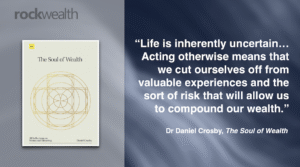
Turning fear into your competitive advantage
Perhaps most importantly, recognise that investment success isn't about eliminating market uncertainty — it's about changing your relationship with it. Just as the anxiety research showed that targeting uncertainty intolerance directly proved more effective than trying to reduce worry symptoms, successful investing requires building comfort with not knowing what markets will do next. This mindset shift transforms uncertainty from an enemy to be defeated into a natural feature of markets that creates opportunity for patient investors. Those who can sit with discomfort whilst others panic often find themselves buying quality assets at discounted prices. Whilst uncertainty-intolerant investors fled to cash during 2008-2009, missing the subsequent recovery, those who maintained their equity positions through the FTSE All-World's 48.5% drawdown were rewarded handsomely as markets recovered.
Embrace the unknown
Learning to embrace uncertainty in investing isn't about becoming reckless or ignoring risk. It's about developing the emotional resilience to stick with evidence-based strategies even when your instincts scream for action. As Lovecraft understood, fear of the unknown is indeed humanity's oldest emotion. But in investing, that fear often extracts a heavy price. By building tolerance for uncertainty, focusing on controllable factors, and maintaining long-term perspective, you can transform this ancient fear from a liability into a competitive advantage. Markets will continue to surprise, politics will remain unpredictable, and economic forecasts will prove wrong. That's not a bug in the system; it's a feature that rewards those brave enough to stay invested whilst others flee to safety.
Get professional guidance
If you're struggling to build confidence in your investment approach or want to explore evidence-based strategies for long-term wealth building, consider speaking with an adviser who understands both the psychology and the practicalities of investing. Contact us at rockwealth to discuss how you can build an investment approach that works even when the future feels impossibly uncertain. WE CAN HELP YOU Here at rockwealth we take an evidence-based approach to investing that works even when the future feels impossibly uncertain. Contact us if you’d like to find out more.